

With increased demand for permeable paving to address issues of SUDS, many driveways, access roads and car parks are now adopting grass paving alternatives.
With more than 50 years of grass paving installations, the Grass Concrete policy is to guide clients to the most appropriate system: in-situ-concrete, pre-cast concrete or plastic systems. This strict fit for purpose policy is the key to achieving sustainability in any construction project, with careful consideration of grass paving types, particularly when likely to be subjected to frequent traffic and weights of vehicles.
SUSTAINABLE PAVING Grasscrete V Block paving
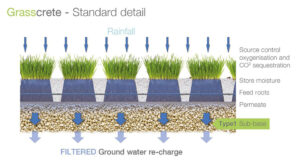
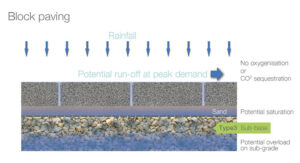
GRASSCRETE – THE SMART CHOICE FOR:
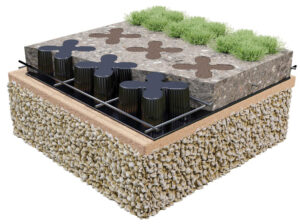
- Fully Reinforced Structure
- CO2 Sequestration
- Re-Oxygenation
- Reducing Urban Heat Island Effect
- Controllable Hydrology
- Naturally Purifying Bio-filter
- 50+ Years of Success
Incorporating SUDS (Sustainable Urban Drainage system) using GRASS PERMEABLE PAVING helps mitigate the implications of surface water run-off and its implications for the local storm water network.
It’s not simply about getting water from A to B, it is about what you do with it along the way. Smart Permeability, using source control to manage the rate of permeability both mitigates downstream impact and provides essential root nourishment for grass coverage.
Sustainable grass cover is best achieved by a system that promotes permeability. The depth and shape of the soil pockets can have a critical part to play. Both Grasscrete and Grassblock offer substantial capacity for soils and root systems to promote maximum grass coverage.
A grass reinforced systems can permeate at up to 90% the rate of natural grass a safe lag time can be achieved. Storing water within the system with low risk of ponding, until the ground can naturally re-charge is a significant benefit.
Lag time is beneficial in the prevention of flooding and can be extended by introducing an underlying drainage blanket across the full extent of the paved area. The drainage blanket can be used to either attenuate permeation to the water table or be a vehicle for rainwater harvesting.